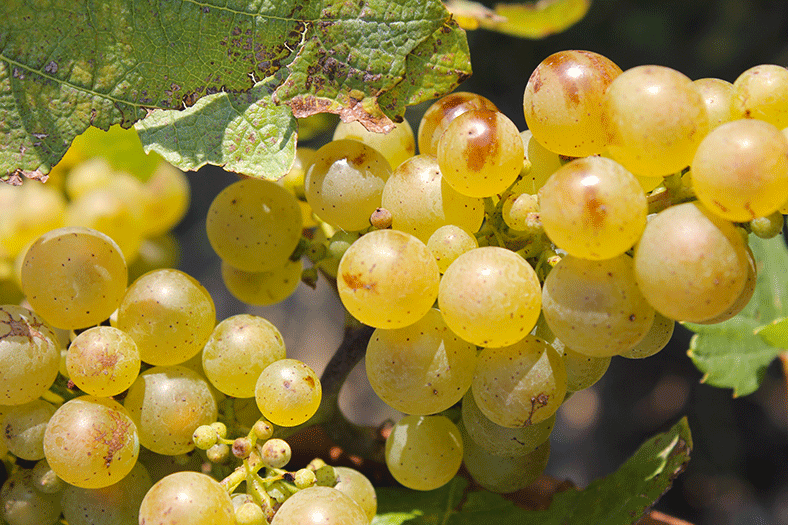
A focus on the Chenin Blanc grape brings us to the heart of the Loire Valley. Source of some of the region’s finest whites – alongside the highly reputed Sancerre – Chenin can be found under many guises. Dry, sparkling, demi-sec, sweet and dessert wines are all crafted from Chenin in the appellations of Anjou, Saumur, and Touraine. A grape variety that can rival the finest Burgundy Chardonnays is more than worthy of your attention…so what are its secrets?
Where does Chenin come from?
Both Chenin Blanc and Sauvignon Blanc belong to a family of grape varieties known as the Messiles, descendants of Savagnin and an as-yet unknown varietal that has been the object of many theories – for now, there are no solid conclusions. Some have postulated that the Chenin grape’s genealogy might include Pineau d’Aunis (sometimes incorrectly named Chenin Noir) or Sauvignon Blanc, but these theories have been thwarted time and time again. More recent DNA studies have revealed Sauvignon and Chenin to be siblings.
Now we can bring the name ‘Meslier’ into the fray. From the Latin “misculare”, which means “mix”, these grape varieties are the result of much cross-breeding in the vineyards. The Messiles family gets its name from the most symbolic of its grapes, Gros Meslier, and equally includes Chenin, Colombard, Menu Pineau, Meslier Saint-François, Mézy, Petit Meslier, Pineau d’Aunis, Plant Vert, Sauvignon Blanc, Sauvignonasse, and Béquignol Noir…Quite a list of tricky names, but they do come out nicely in the winery!
Getting to know Chenin
History of the grape
We know that King Charles the Bald gifted two vineyards to the Abbey of Saint-Maur de Glanfeuil in Anjou all the way back in the year 845 – on 14th August, to be exact. Unfortunately, though, there is no written evidence that these particular vineyards were planted with Chenin.
The first known mention of the Chenin grape dates from 1469, as cited by Casimir Chevalier 400 years later. On 3rd January 1469, Thomas Bohier bought some land near to Chenonceau, where he planted “nine rows of vines, with plants brought in at great cost from Orléans, Arbois, Beaune and Anjou”. The grape imported from Anjou was a white variety, highly likely to have been Chenin Blanc! There are more written mentions of this Anjou plant throughout the Château de Chenonceau archives, and the grape came to be widely planted in the area due to its excellent adaptation to the local climate.
The most likely origin of the name “Chenin” is linked to the Montchenin Abbey, where it found an early home in the local vineyards. For a while, it was also known as Plant d’Anjou and Pineau de la Loire. In the 25th chapter of his ‘Gargantua’ (1532), Rabelais cites the grape: “This done, the shepherds and shepherdesses made merry with these cakes and fine grapes, and sported themselves together at the sound of the pretty small pipe, scoffing and laughing at those vainglorious cake-bakers, who had that day met with a mischief for want of crossing themselves with a good hand in the morning. Nor did they forget to apply to Forgier’s leg some fat chenin grapes, and so handsomely dressed it and bound it up that he was quickly cured”. (Translation based on that of Gustave Doré (1894) at Project Gutenberg.)
Geography
The Chenin grape thrives when planted in the Loire Valley, where it has made a name for the appellations of Jasnières, Vouvray, Montlouis, Anjou, Saumur, and Quarts de Chaume, to name just a few. It is made into dry, demi-sec, sparkling, sweet, and even dessert wines. Chenin is also widely planted in South Africa, as well as in the US, Australia, and Argentina.
Profile
When made into a dry white wine, Chenin stands out for its fruit-based aromas of quince, citrus, ripe yellow fruits, and even exotic fruits in the case of richer cuvées. Other notes you might sense are those of lime blossom, honey, vanilla, and sweet spices, aromas that develop from the maturation process. After ageing, some of the finest Chenin Blanc wines (such as those from Montlouis and Vouvray) even reveal notes of truffle. Since Chenin is particularly well-adapted to cooler climates, it tends to hold onto its acidity well; this translates into a good potential for cellaring. This acidity can allow the aromas to linger on the palate for longer, though it can make some wines somewhat austere.
For the sweet wines made from Chenin, you’ll likely find cuvées with a golden hue and a complex nose; the broad aromatic palette can include hints of candied, jammy fruit like apricot, quince, and pineapple, as well as honey and sweet spices.
As for sparkling Chenin wines, these tend to be lively and subtle, expressing their complexity through notes of yellow fruit, quince, nuts, citrus, and white flowers.
The finest Chenin
Chenin, like Chardonnay, doesn’t have a strong aromatic profile, making it a blank canvas to be translated into something more complex in whichever style the fine vigneron chooses to use to craft it. Some wine-lovers consider the Loire’s best Chenin Blancs comparable in quality to Burgundy’s top Chardonnays (and at much more attractive prices…).
The most emblematic Chenin cuvées come from a handful of appellations and winemakers who have understood the nuance of this variety:
- Anjou: Richard Leroy (Les Noëls de Montbenault, Vin de France), Stéphane Bernaudeau (Les Nourrissons, Vin de France), The Picrate (Eric Calcutt, this estate no longer exists), Les Jardins Esmeraldins (Xavier Caillard), Coulée de Serrant, La Ferme de la Sansonnière (Mark Angeli)
- Saumur: Clos Rougeard (Saumur Brézé), Domaine du Collier (Saumur), Guiberteau (Saumur)
- Touraine: Clos Naudin – Philippe Foreau (Vouvray), Huet (Vouvray), La Taille aux Loups (Montlouis), Francois Chidaine (Montlouis)
iDealwine has some 70 partner estates in the Loire Valley. Here are some noteworthy wineries whose Chenin Blanc is crafted beautifully: Antoine Sanzay (Saumur), Arnaud Lambert (Saumur), Belargus (Anjou Noir), Bonnigal-Bodet (Touraine-Amboise), Château de Plaisance (Anjou), Château de Villeneuve (Saumur), Bellivières (Jasnières), Roches Neuves (Saumur), Rocher des Violettes (Montlouis), Laureau (Savennières), la Grange Tiphaine (Montlouis), Lise et Bertrand Jousset (Montlouis), Ogereau (Anjou), Patrick Baudeau (Anjou), Sébastien Brunet (Vouvray), Terra Vita Vinum (Anjou), Vincent Carême (Vouvray), Bernard Baudry (Chinon)…
Chenel, a descendant of Chenin
The descendants of Chenin are varieties very infrequently grown now, but which express many of the characteristics found in their ancestor. Widely cultivated in South Africa, the Chenin grape has recently given birth to a new creation! A few years ago, the varietal was crossed with Ugni Blanc, producing a grape known as Chenel. The new wines crafted from these vines are very rich in character, and for now the results are mixed. Perhaps it hasn’t yet found its home region? Come back in 500 years’ time, and we’ll see if iDealwine’s archives help scientists trace the origins of South Africa’s Chenel grape…
See our selection of Chenin wines from the Loire
Blog article also about grape varieties:
Grape guide | Chardonnay around the world