
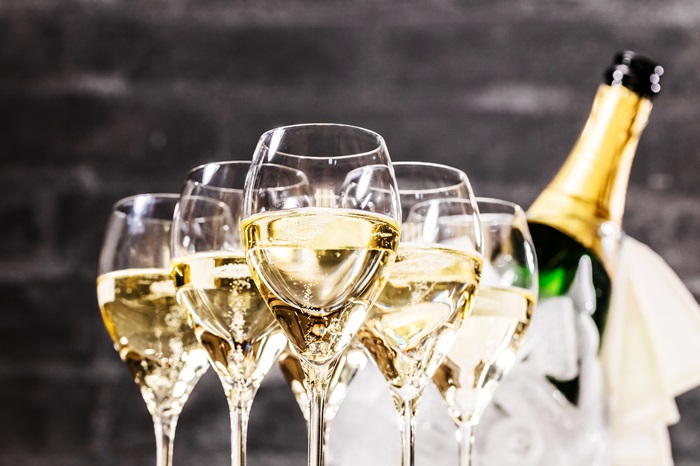
The traditional method of making Champagne, known as méthode champenoise, a term now legally protected, was perfected during the 18th and 19th centuries. So how exactly is Champagne made? Let’s take a closer look at the process behind its famous bubbles.
What’s the story behind Champagne?
Like many winegrowing regions across France, Champagne is thought to owe its origins to the Romans, who brought their winemaking expertise to then Gaul. Over the centuries, the region’s wines grew in prestige, helped in no small part by their association with the coronation of French kings at Reims Cathedral in the heart of the region. Champagne’s still wines were already highly prized, particularly by King Louis XIV of France, long before winemakers mastered the art of producing its famous bubbles. It took almost two centuries of trial and error to perfect the technique that would eventually make the region’s fortune.
Legend has it that Dom Pérignon, a 17th-century Benedictine monk at Hautvillers Abbey, devised a way to stabilise the naturally sparkling wine produced in the region’s cool cellars, where low temperatures interrupted fermentation before the yeasts could convert all the grape sugars into alcohol. His supposed secret? Adding sugar to the wine.
Champagne terroirs
Before taking a closer look at how Champagne gets its famous bubbles, let’s explore what makes it one of the world’s most celebrated wines. After all, behind each great wine lies a great terroir.
Grand Cru and Premier Cru: Champagne’s vineyard hierarchy
The Champagne region’s vineyards extend across some 319 crus, of which 17 villages are classified as grand cru and 42 as premier cru. This classification was established in the 19th century, based on the quality of the grapes grown in each village.
You may already be familiar with Champagne’s three best-known winegrowing areas: the Montagne de Reims, the Côte des Blancs and the Vallée de la Marne. Each is particularly well suited to a different grape variety.
The grape varieties
Three grape varieties are largely responsible for Champagne’s prestige: Chardonnay, Pinot Noir and Pinot Meunier, often simply called Meunier.
Let’s start with Chardonnay. Unsurprisingly as a white variety, it dominates the Côte des Blancs and is the sole variety used in the region’s celebrated Blanc de Blancs Champagnes, white wines made exclusively of white grapes. Chardonnay can also be blended with other grape varieties. It produces lively, fresh and sometimes delicate wines, with floral and crisp fruit aromas. Thanks to its naturally high acidity, it also offers excellent ageing potential.
Pinot Noir comes into its own in the Montagne de Reims, producing wines that are often complex in character. This variety is either used on its own or as part of a blend.
Pinot Meunier, meanwhile, thrives in the Marne Valley, producing fruit-driven sparkling wines that generally have less ageing potential.
Other grape varieties can also complement Champagne blends and are enjoying renewed interest among winegrowers keen to explore the full potential of their terroirs. These include Arbane, Petit Meslier, Pinot Blanc and Pinot Gris.

The people behind Champagne
So who makes the Champagne whose bubbles are celebrated around the world? As wine lovers know, Champagne production is dominated by two distinct groups: the prestigious Champagne houses and independent winegrowers.
The Champagne houses
For centuries, the great Champagne houses, each with its own remarkable history, have helped build the international reputation of the region’s sparkling wines. While they own vineyards, Champagne houses source most of their grapes or grape must from carefully chosen local growers and winemakers. The Champagne houses then ferment the juice and mature the resulting wines in their cellars, under the watchful eye of a cellar master skilled in the art of blending. Quality is often excellent, but above all, the houses are known for maintaining a consistent style and standard from one vintage to the next. Choosing a Champagne from one of these houses means buying into its history, distinctive style and identity.
Champagne’s independent winegrowers
There’s no denying it: grower Champagnes are becoming increasingly popular. Wine and Champagne lovers are now looking for wines that express their terroir, wines with authenticity and wines with a soul. A soul? Of course, but not any old soul… the winegrower’s one, quite naturally. And behind every great wine are great grapes. With an intimate knowledge of their land, these winegrowers adapt their viticultural practices to bring out the best in Champagne’s chalky soils. They also oversee the winemaking process, crafting wines that capture the character of the vintage and the soils in which the grapes were grown. Choosing a grower Champagne means discovering an individual style and letting the grapes tell their own story.
How is Champagne made? A closer look at the winemaking process
Now to the question at the heart of this article: why does Champagne have bubbles? To find out, we need to understand how this celebrated wine is made. So let’s head down into the cellars and discover what happens behind the scenes.
As we’ve mentioned, the story of how Champagne’s bubbles came to be tamed is said to date back to the 17th century, and it probably began with a happy accident. Champagne has a cool climate, with temperatures regularly dropping below 15°C in the month following the harvest, bringing the fermentation process to a halt. Any sugar that had not been converted into alcohol remained in the wine. Shipped in barrels along rivers or by sea, Champagne wines eventually reached English wine merchants, who bottled and corked them. When temperatures rose the following spring, alcoholic fermentation resumed, releasing carbon dioxide (CO₂). This time, however, the gas was trapped inside the bottle, only to escape when it was uncorked.
So how do winemakers produce and preserve those bubbles in Champagne today? The principle is simple: retain some of the carbon dioxide produced during fermentation inside the bottle, rather than allowing it to escape, as it normally would from open fermentation vats. Here’s a step-by-step look at how Champagne is made.
Making the still base wines
The process begins with the production of still wines, which are then blended, although this is not necessarily the case for Blanc de Blancs or Blanc de Noirs Champagnes.
The term cuvée refers to the juice from the first pressing, considered the purest and finest. Any juice from subsequent pressings is known as the taille. With this information, we can surmise that the finest Champagnes are made exclusively from the cuvée.
To obtain the cuvée, the grapes are lightly pressed to prevent the skins from imparting colour to the juice. The resulting must is then fermented in stainless steel vats, oak barrels or a combination of the two.
Blending
Champagne is renowned for its blends of different grape varieties, vineyard plots and vintages. Given the region’s sometimes challenging climate, blending allows Champagne houses to maintain their signature style year after year. It’s worth noting that the wines are still – i.e. they have no bubbles – at the blending stage.
Bottling, also known as tirage
The carefully blended wine is then bottled with a liqueur de tirage, a mixture of sugar and yeast. This triggers a second fermentation in the bottle, during which the yeast converts the sugar into alcohol, releasing carbon dioxide in the process. And that’s when the bubbles begin to form!
Ageing
Champagne has its own particular ageing requirements, with minimum periods laid down by law and the bottles stored sur lattes (on laths, stacked horizontally): Fifteen months for non-vintage Brut Champagne, including at least 12 months on the lees (the dead yeast cells), and at least three years for vintage Champagne, again including a minimum of 12 months on the lees. Some Champagne houses and growers choose to age their wines for considerably longer, allowing them to develop greater complexity and harmony.
Riddling
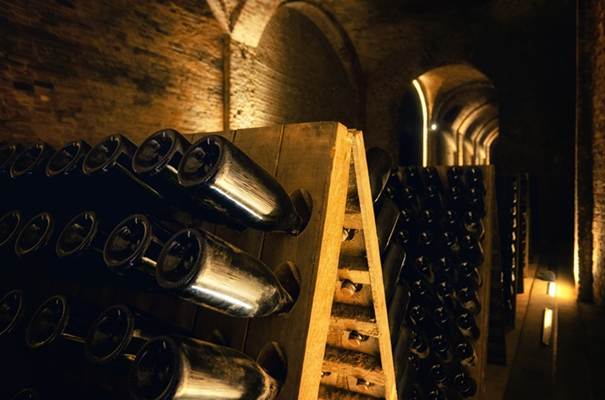
To gently clarify the wine, the bottles are placed on angled riddling racks, an innovation pioneered and popularised by Barbe-Nicole Clicquot Ponsardin, better known as the Madame Veuve Clicquot. The bottles are regularly rotated, either by hand or mechanically, to encourage the sediment to collect in the neck of each bottle.
Disgorgement
The next step is to remove this sediment. To do this, the bottle neck is immersed in a brine solution at -27 °C, freezing the sediment into a small plug of ice. The pressure built up inside the bottle then forces the frozen plug, along with the trapped sediment, out of the neck. This crucial stage also brings the wine back into contact with oxygen for the first time in many months.
Once the ice plug is expelled, the space it leaves behind may then be filled with a liqueur d’expédition, also known as the dosage liqueur, containing sugar. The amount of sugar added determines the Champagne’s sweetness classification: Brut Nature, Extra Brut, Brut, Extra Dry, Sec, Demi-Sec or Doux. Many Champagne lovers wonder whether a dosed Champagne is better than one with no dosage at all. What’s your take on this?
Champagne: what makes its bubbles so special?
Now that we’ve covered the basics, here are a few more things worth knowing about Champagne.
A protected name
As the saying goes, “Champagne only comes from Champagne.” Its production is governed by strict regulations based on the traditional method of winemaking, commonly known as the méthode champenoise. The name Champagne is legally protected, and no other sparkling wine can use it.
Vintage or non-vintage Champagne: does it make a difference to the bubbles?
As we’ve already touched on, the ageing requirements for non-vintage Brut Champagne (also known as Bruts Sans Années) and vintage Champagne differ considerably, and this often has an impact on the quality of the bubbles. With longer ageing before release, and the potential to mature further in a wine lover’s cellar, vintage Champagne tends to develop a finer, more delicate mousse, making it particularly well suited to the dinner table.
Rosé Champagne
One more twist in the fascinating world of winemaking: pink bubbles! As you may know, rosé wine can be made using two different methods. Only one of these methods is permitted in Champagne: rosé d’assemblage, which involves blending white and red wines from Champagne, made from Pinot Noir or Rosé des Riceys, before the second fermentation.
Who knew something so bubbly could be so strictly regulated?
Also on the iDealwine blog:
Ageing gracefully? Which Champagne to keep in your cellar


