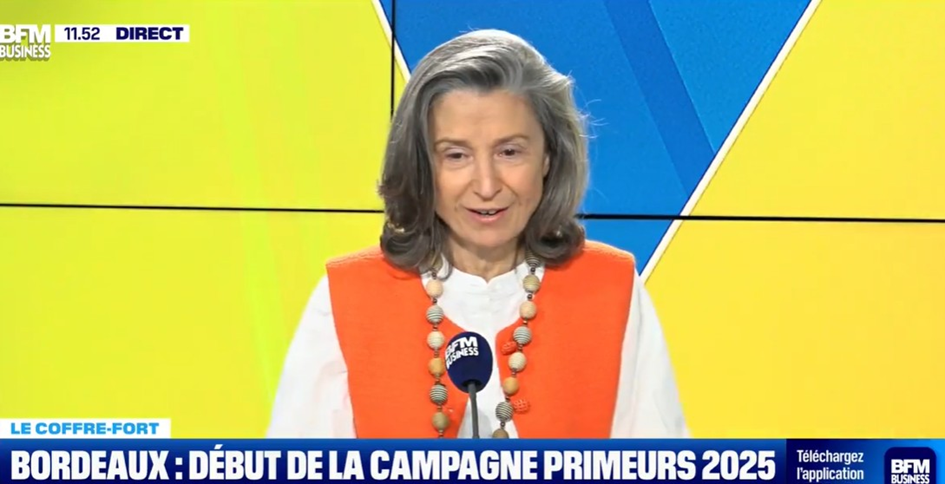
Every year, the first weeks of spring are marked by a major event for fine wine enthusiasts: the Bordeaux En Primeur campaign. In the current economic climate, should we be interested in them and dive into the En Primeur world? Are Bordeaux wines an interesting option for investment or pleasure purchases? Angélique de Lencquesaing, iDealwine co-founder, was asked these questions by Etienne Bracq on the French news channel BFM.
Angélique, how is this En Primeur campaign unfolding?
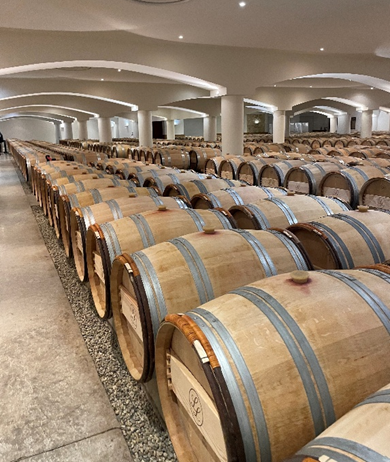
While the idea of purchasing a “harvest” from wine merchants dates back to the 18th century, En Primeur sales have been available to private clients since the 1970s. The principle? Bordeaux’s grand crus have been selling the fruits of their latest harvest – this year, it’s the one from 2025 that’s up for sale – before the wines are even bottled. The wines are currently still in the process of maturing.
The wines are tasted by the press, professional tasters, and distributors during the month of April, and then these professionals publish their tasting notes and comments to help potential buyers. Once the campaign itself begins (this year, it started quite early, at the end of April), the wines sold through a chain of négociants, wine merchants, and distributors. Wine enthusiasts select the wines from their favourite estates, as buying them En Primeur guarantees them access to the vintage. Their orders will be shipped once the wines have been bottled – typically 18 to 24 months after having placed their order (or more for some sweet wines).
What’s the point of buying En Primeur?
There are three main benefits:
- The guarantee of securing a rare wine, when there is scarcity – which isn’t always the case but 2025 will certainly be hard to come by later – while it’s still available once bottled.
- A short supply chain, straight from the estate to your cellar. The wines are shipped from the property’s cellar to our warehouses, then to your home or your storage location.
- And the key argument is price. The En Primeur system helps estates finance their stock during the ageing process. In return, buyers get the wine at a lower price than when the wine is properly released by the château after bottling. This is the founding principle of the En Primeur model.
Buying unfinished wine En Primeur is a gamble. How can buyers stack the odds in their favour?
Three things can guide your choice:
- The characteristics of the vintage and its “desirability”
- Tasting notes, and how professional tasters perceive the wine
- The price, a key argument
I’d add that the En Primeurs is a rather unique way of purchasing wine because you’ll need to wait several years before you can actually enjoy the wine. It’s a patient purchase, tied to the pleasure of building a collection over time to pass onto the next generation. This year, many enthusiasts are contacting us to purchase the wines from 2025 as it corresponds to a special anniversary (the birth of a child, marriage…).
What can be said about the 2025 vintage, in general?
The weather has constituted a significant constraint for Bordeaux vine-growers. After a gentle spring and favourable conditions that promoted flowering, scorching temperatures hit the region in the summer. The vine was this subjected to water stress, which can block the grapes from ripening. Fortunately, life-saving rain came to rehydrate the vine a few weeks before harvest, which took place in good conditions, giving winemakers a wide window of opportunity to harvest the grapes gradually, depending on their ripeness.
Was it a generous harvest?
The water stress the vines experienced limited berry growth. The vine switches to “survival” mode when there is not enough water present, meaning that the grapes are small and dense. No, it was not a productive year; on the contrary, 2025 is expected to mark the lowest harvest across the whole of France in 60 years. A rarer production, generally speaking, marked by small yields at numerous properties. Some have seen their production halved.
Nevertheless, 2025 honours the reputation for quality associated with vintages ending in a “5″. The wines tasted in Bordeaux in recent weeks have brought smiles to the professionals who made the trip there. The wines are concentrated, with a beautiful acidity and preserved freshness.
Is it an interesting vintage, from an investment point of view?
Wines from the 2025 vintage have several qualities that could make them perfect for investment.
The primary advantage is economic: Bordeaux, notwithstanding the harsh winds that blow about this region, remains a reference worldwide. If you look at the auction market, which iDealwine knows well, having conducted analysis from every angle for over 25 years, Bordeaux remains a leading region traded on the secondary market in terms of volumes. One bottle in every three that went under the hammer on iDealwine in 2025 was a Bordeaux grand cru, and the volumes sold increased by 23% last year on the website. Bordeaux can count on solid markets in Europe (France, Switzerland, Spain, Scandinavia), as well as some in Asia (Singapore).
Another advantage of Bordeaux wines is their ageing potential – imperative when investment is part of the purchasing decision – is proven. The level of acidity present in the wines can attest to it. The wines can be appreciated in their youth – the deliciousness of certain wines was promising during the tastings – and this is indeed an important point in the stylistic evolution of Bordeaux wines, but they are also structured to be aged for many years. Indeed, this is one of Bordeaux’s great strengths, an asset that lies in the art of the blend.
Could we call it an attractive vintage?
At iDealwine, we are already gauging consumer anticipation. Given the setup of the website, we can judge the “desirability” of the vintage by the number of alerts placed on wines that will be available En Primeur over the coming weeks. This feature allows customers to be notified as soon as a wine has been released and available to purchase. The number of alerts has increased by a third compared to last year, indicating the appeal the vintage has generated among enthusiasts. It will be a particularly interesting vintage when 2025 marked a special occasion: a wedding, a birth, or a big birthday.
We are still missing two elements to fully answer your question: the ratings from top tasters, which should help to establish consensus on certain wines or, at least, on certain appellations. It should be said that the era during which the Top Parker scores could make or break the vineyard is over.
Another key factor in judging the interest in buying Bordeaux wines En Primeur: the price, of course. The decision is always complicated for a property, and this year perhaps more than ever.
How come?
Exogenous factors to the wine market (the war in Ukraine, the Iranian conflict, …) are weighing on trade. Economic factors are added to this (increase in the cost of raw materials and fuel that weigh on purchasing power) which are likely to deter consumers from their spending.
And then there are factors specific to the wine market: the 2024 campaign was not successful, leaving significant stocks in château’s cellars. Rising interest rates are hindering the financing capacities of négociants. On top of that, consumption trends direct enthusiasts towards white wines or light wines that are ready to drink quickly and to keep fine red wines for special occasions… All these factors will come into play in determining the sales price.
Will the unfavourable economic context steer these prices downward?
It will be difficult for some producers affected by cost increases because a reduction is not economically viable, especially with a low-quantity harvest. In the current context, and given the quality of the vintage, stable prices would send a positive signal of moderation, encouraging a recovery in sales.
The consumer is ready and waiting, they are interested, this vintage generates anticipation and hope, and is comparable to good years such as 2022, 2020 or 2019, in recent times. Consumers are just waiting for a gesture to reciprocate their interest.
Do you have some favourites?
Our team had many! Particularly within the appellations of Pessac Léognan, Margaux or Pauillac, further north, and, on the Right Bank, Pomerol and Saint-Emilion. We may have the opportunity to revisit this topic, depending on the release prices. To be followed closely…