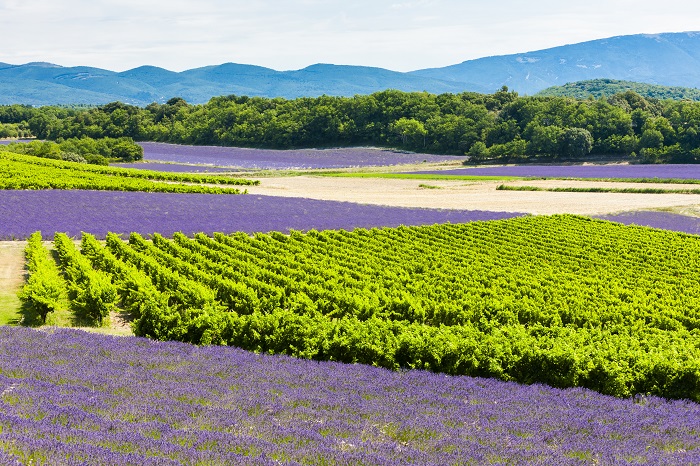
Just saying the word Provence brings the Mediterranean Sea, lavender fields, sun and vines to mind. In this region where cicadas sing, wine enthusiasts can find some delicious gems. But how to find them? Is the 1955 classification of Provence wines still relevant today? We’ll answer these questions while taking you on a tour of this beautiful region.
A story that started more than a century ago
The first murmurs of classification started at the end of the 19th century, in 1895 to be exact, when a few properties grouped together to try to find a way to shine the spotlight on their viticultural knowledge just like what had happened in Bordeaux with its 1855 classification. After a few decades of back and fore, a first classification of Provence cru classés was created by the Marseilles governor in 1943. This initial classification was based on four criteria:
- Direct sales to the consumer
- Bottling at the property (which was uncommon at the time)
- Release onto the market after a minimum of 18 months in the cellar
- Use of an appellation or a brand before 1935
In 1951, the French National Institute for Origin and Quality (INAO) recognised this new hierarchy and in 1955, 23 producers out of the 300 in existence at the time were allowed to add ‘cru classé’ to their labels. Probably a coincidence; the Saint-Émilion grand cru classification became official that same year.
But the story doesn’t end there as a separate appellation was established in 1977 to promote the wines of three departments – Var, Bouches-du-Rhône and Alpes-Maritimes – and it was called AOC Côtes de Provence.
The 18 Provence Cru Classés of today
The 18 Provence Cru Classés are:
- Château Minuty
- Château Sainte-Roseline
- Domaine de la Source Sainte-Marguerite (now Château Sainte-Marguerite)
- Domaine de la Clapière
- Domaine de l’Aumérade
- Clos Cibonne
- Domaine de Rimaurescq
- Domaine de Castel Roubine (now Château Roubine)
- Château du Galoupet
- Château de Saint-Martin
- Château de Saint-Maur
- Clos Mireille (Domaines Ott)
- Château de Selle (Domaines Ott)
- Château de Brégançon
- Domaine de Mauvanne
- Domaine de la Croix
- Domaine du Jas d’Esclans
- Domaine du Noyer
However, this classification is based on precedence rather than qualitative criteria, so naturally it is questioned (and debated). Many estates produce several wines, all of which carry the ‘cru classé’ wording on their labels, which differs from Bordeaux for example where only the top wine is allowed to bear this accolade. Furthermore, vineyard plots may be added to or removed from the cru classé depending on purchases by the properties (as is the case in Bordeaux).
No changes are planned to be made to the list.
Shop all cru classés for sale on iDealwine
Of the 23 properties included in the 1955 classification, five have since ceased production. They are:
- Clos de la Bastide Verte in La Garde,
- Domaine de la Grande Loube in Hyères,
- Clos du Relais in Lorgues,
- Coteau du Ferrage in Pierrefeu,
- Domaine de Moulières in La Valette.
Among the 18 properties still operational, 14 decided to group together in 2000 to create a collective voice to defend their title and promote their wine, bringing about the creation of a Charter of Excellence in 2005.
Characteristics of AOC Côtes de Provence Cru Classés
The Côtes de Provence appellation is the only regional AOC to create a list of cru classé, and the vines can be found in an area divided into five zones:
- Montagne Sainte-Victoire
- A thin strip of land running along the Mediterranean Sea
- The Beausset basin
- The limestone hills to the north
- The inland valley
In a Mediterranean climate, the vines get their nutrients from often limestone soils that also contain sandstone, marl, granite and alluvial sand. These vineyards are often home to varieties such as the Grenache, Syrah, Carignan, Tibouren, Cabernet Sauvignon and Cinsaut, which ultimately produce wines that are generally quite pale, revealing delicate notes of small red fruits, stone fruits, pomelo, subtle spices, and flowers.
These cru classés are known for their elegance and how they reflect the terroir. They are rosés perfect for being paired with food such as grilled fish, white meat, Chinese dishes, as well as typical Provençal recipes.