It is becoming increasingly common to hear Champagne producers refer to their cuvées as ‘undosed’ or with ‘little dosage’. But what do these words mean? Is an undosed Champagne better?
What does dosage mean in Champagne?
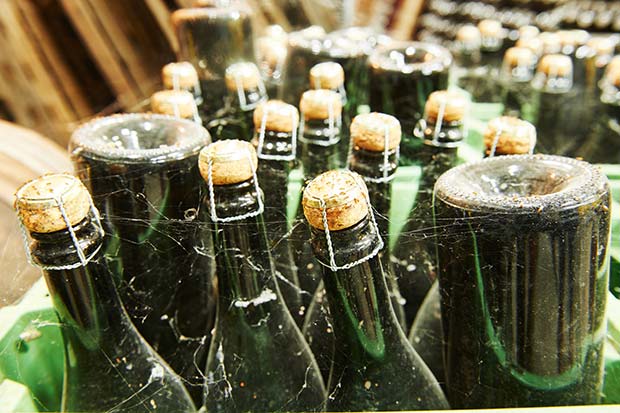
Champagne is quite a complex wine to make. To begin with, a ‘normal’ white wine is made, dry and still, sometimes made from white grapes but often from black ones, then matured in vats or barrels (generally until April or June). After the base wine are blended, the next step is tirage, when the base wine is bottled and a liqueur de tirage is added (with yeast and sugar in it) in order to start a second fermentation in the bottle. This is when the still base wine becomes a sparkling wine, as the wine absorbs the carbon dioxide released during fermentation. It can then be left to age for a bit (at least 15 months depending on the demands of the appellation) or for a lot longer (sometimes several years for fine, vintage Champagnes).
Once matured, the wine is disgorged (meaning that the deposits are removed) and the bottle is stoppered with a cork after the addition (or not) of what is known as a ‘liqueur d’expédition’, a mixture made of reserve wine and pure cane sugar. The quantity of residual sugar in the bottled wine (natural sugar from the grape as well as added sugar) is called the dosage and will determine the type of Champagne. The amount of dosage in the wine is defined as followed and each dosage level has its own name in French:
- Brut Nature: No added sugar and less than 3g/litre of residual sugar
- Extra-Brut: Between 0 and 6g/litre of residual sugar
- Brut: Between 7 and 12g/litre of residual sugar
- Extra-Sec: From 12 to 17 g/litre of residual sugar
- Sec: From 17 to 32 g/litre of residual sugar
- Demi-Sec: From 32 to 50g/litre of residual sugar
- Doux: More than 50g/litre of residual sugar
These dosage names can also be seen on sparkling wines made from other French appellations or in other countries.
What is the significance of the dosage in Champagne?
Without added dosage, the intrinsic qualities of the wine and its terroir can be better highlighted. Any minerality, partially or even entirely masked by the dosage, is also better perceived. The complexity of the wine is greater in terms of the richness of its aromas. For the last two centuries, an increasing taste has developed for less heavily-dosed Champagne. In the 19th century, Champagne was made very sweet, with levels of residual sugar between 50 and 100 g/litre, if not more. Today, Demi-Sec and Doux Champagnes are rare.
Evidently, if undosed Champagnes are to be enjoyable to consumers, they have to be made from superb grapes that have reached a sufficient level of maturity. If not, the wine’s acidity can be too bitter. This is why most lower-quality Champagnes are heavily dosed, so as to avoid an acidity that renders them unpalatable. If you’ve wondered why you’re not feeling great after drinking cheap Champagne, it’s the sugar along with the high level of acidity that could turn your stomach.
Obviously, all the Champagnes on iDealwine have undergone a rigorous taste test and are the perfect quality to keep our tastebuds happy; even those with a smaller price tag will delight them.
See all the Champagnes available on iDealwine