First there were organic wines. Then we heard about biodynamic wines. Finally, in the past twenty years, a new concept has surfaced, that of “natural wine”. While nowadays it is fairly simple to understand what qualifies as ‘organic’ or ‘biodynamic’ thanks to articles and certifications, the term ‘natural’ is much more difficult to grasp. Below, we try to help clear things up.
A passing trend or lasting phenomenon?
Although the notion of natural wine is much more difficult to understand than that of organic or biodynamic, this is first and foremost for a purely technical or administrative reason. While organic and biodynamic wines are labelled by independent certification agencies (Demeter, Ecocert, Biodyvin, etc.), natural wines have no official label, even though the AVN (Association of Natural Wines) has written a cahier des charges, they don’t have the same means of control as organic or biodynamic certification bodies. Having said that the idea of natural wine is not new, but the current upward trend started in the 1990s.
“Natural” – The magic word?
It’s worth noting that since the emergence of diverse environmental schools of thought, the word ‘natural’ has become as good as magical, adorned with every possible virtue. On their website or in their communication, you will see many winemakers who are not at all organic but like to declare that their work is carried out “with total respect for nature”, which, of course, doesn’t mean anything… However, for the past half-century, as consumers in general, and wine enthusiasts in particular, we have the impression that what we eat and drink is better – in terms of taste or at least better for our health – when these products are as natural as possible. Labels such as “without preservatives” or “without colouring agents” are supposed to flatter consumers’ propensity for all that is natural. This trend has become ever more prevalent, leading producers to follow very precise criteria allowing them to label their products as organic. In very simple terms, for wine, this means that vines have been cultivated without any synthetic herbicides or insecticides. Organic labels have however remained silent on the subject of the actual winemaking process…
Little information shared
Short digression: In comparison to other pre-packaged food products, where every ingredient is included on the packaging in minute detail, the label on a bottle of wine (or beer, cider, etc.) was fairly empty until December 2023. The alcohol percentage and whether it contained sulphites (without giving precise numbers…) was all that was stated.
What is natural wine?
It’s therefore this dual concern – the desire for a return to what is ‘natural’ and transparency regarding what is actually in a bottle of wine – that led to the new trend of natural wines.
The AVN has put together a production specification (cahier des charges in French) for natural wine, which can be summarised as follows:
- The objective of AVN winemakers is to produce wines “produced using natural vinification”, that’s to say, with no added inputs or additives (isinglass (a clarifying agent from fish), egg whites, enzymes, added yeasts, sugar, tannins… In total, 49 additives are authorised for conventional wine, 38 for organic, 5 for biodynamic and only one for natural wine – sulphur dioxide. Low doses are allowed with the limits set to 30mg/L for red wines and 40mg/L for white wines)
- The vines are farmed in such a way that respects organic or biodynamic agriculture
- Harvests must be done by hand
- Only indigenous yeasts – those found on the grape skins – are used in the winemaking process
- The grapes’ original constitution cannot be voluntarily modified, and no recourse to physically ‘brutal’ techniques (inverse osmosis, tangential filtration, flash pasteurisation, thermovinification) is authorised
For wine enthusiasts, natural wines are often summarised as those with no or very little added sulphur (sulphites, SO2, and sulphur dioxide are all the same thing, just the form of the sulphur changes). Tis explains how, for the most part, many high-quality estate have the same practices regarding work in the vineyards, harvests, yeasts, or avoiding brutal manipulation of the wine during its production.
For or against?
The central issue regarding natural wine is therefore the presence of sulphites. What’s more, wine enthusiasts will often talk about ‘wine without sulphites’ to describe a natural wine. If it hasn’t happened to you yet, just listen to an impassioned debate between partisans of ‘zero sulphur wine’ and those who enjoy ‘conventional’ wines. The former will claim that they cannot drink wines which give them a headache, laden with chemicals and whose aromas are locked away by the sulphur, whereas the latter will ask themselves how you can drink white wines which resemble cider and red wines that seem oxidised even though they’ve only aged for two years in the bottle. As with all debates, there are many points of view.
The reality of the sulphite issue is much more complex than it might seem at first glance. Sulphur being first and foremost a preservative and bactericide, in a perfect world we could easily go without it. With a ripe, perfectly healthy harvest, without any trace of rot, a clinically clean cellar, and little handling of the must, adding no sulphur would be feasible. We’re talking about ‘added sulphur’ here, as the fermentation process itself produces a small amount of natural sulphur. However, these conditions are not always possible, and there are many producers who, despite following the natural wine philosophy very closely, don’t think twice about adding almost homeopathic amounts of sulphur to their wines so that they have more chance of staying stable once in the bottle. Should we banish them from the natural wine family just for that? Of course not, as it would be extremely sectarian. Yet the natural wine scene has unfortunately engendered some zero sulphur tyrants, who aren’t afraid of talking about great terroir when a wine is completely ‘supernatural’, teeming with serious faults, even for a tolerant taster!
More than a trend, progress that benefits everyone
Beyond the excesses inherent to all fashions, the fact remains that this alternative way of producing wine, originally pioneered by a small group of ‘gentle dreamers’, can be extremely profitable for many winemakers. Faced with two, good quality wines, who wouldn’t prefer the one with the least possible amount of additives, whose grapes were cultivated without pesticides or other synthetic products, and whose amount of added sulphur is minimal, but has retained all of its ‘drinkability’? Nowadays, under the influence of natural producers’ sometimes dogmatic practices, it’s clear that the good winemakers add much smaller amounts of sulphur to wine during production. Ultimately, we can’t complain, as fewer sulphites means wines which are both better for our health and much freer in their aromatic expression.
Natural wine rankings from iDealwine auctions
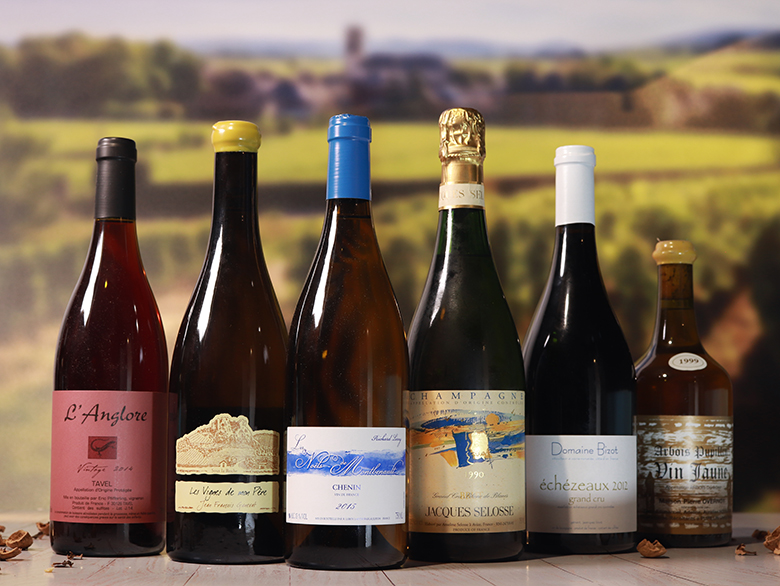
For anyone needing proof that natural wine is not a passing trend, bottles produced according to its production specifications set records at auction. Here is the rankings of natural wines ordered by their prices which went under the hammer on iDealwine in 2024.
Top 20 highest priced natural wine bottles in 2024
| Position | Region | Lot description | Lot hammer price | Lot hammer price scaled to 750ml | Buyer/ Auction date |
| 1 | Burgundy | 1 bt of 2009 Echezeaux GC (red) – Bizot | €5,125 | €5,125 | Private – France April 2024 |
| 2 | Champagne | 1 bt of 2008 Extra-Brut Premier Cru Millésimé (sparkling) – Jacques Selosse | €2,250 | €2,250 | Private – France December 2024 |
| 3 | Burgundy | 1 bt of 2018 Bourgogne En Belle Rose (red) – Les Jardins Vivants (Tino Kuban) | €1,913 | €1,913 | Private – France March 2024 |
| 4 | Rhône | 1 bt of 1999 Cornas Cuvée sans soufre (red) – Thierry Allemand | €1,625 | €1,625 | Particulier – Denmark November 2024 |
| 5 | Burgundy | 1 bt of 2020 Chambertin Clos de Bèze GC (red) – Prieuré Roch | €1,563 | €1,563 | Private – Singapore September 2024 |
| 6 | Burgundy | 1 bt of 2021 Charmes-Chambertin GC (red) – Kei Shiogai | €1,438 | €1,438 | Private – Italy December 2024 |
| 7 | Jura | 1 bt of 1998 Arbois Pupillin Vin Jaune (white) – Pierre Overnoy | €1,125 | €1,361 | Private – France August 2024 |
| 8 | Jura | 1 bt of 2016 Vin de France Mizuiro Les Saugettes (white) – Domaine des Miroirs | €1,200 | €1,200 | Private – Hong Kong January 2024 |
| 9 | Italy | 1 bt of 2001 Brunello di Montalcino DOCG Riserva (red) – Case Basse (Gianfranco Soldera) | €1,188 | €1,188 | Professional – Italy March 2024 |
| 10 | Champagne | 1 bt of Champagne Roses de Jeanne Cuvée Inédite RDJ Numéro 2 (sparkling) – Cédric Bouchard | €1,125 € | €1,125 € | Private – South Korea April 2024 |
| 11 | Loire | 1 bt of 1996 Vin de France Les Nourrissons (white) – The Picrate (Eric Callcut) | €1,088 | €1,088 | Private – Switzerland November 2024 |
| 12 | Loire | 1 bt of 2004 Vin de France Génèse (white) – Les Jardins Esmeraldins | €1,063 | €1,063 | Private – Hong Kong October 2024 |
| 13 | Loire | 2 half-bt of 2007 Vin de France Champignon Magique (white) – Pierre Beauger | €918 | €918 | Private – South Korea November 2024 |
| 14 | Burgundy | 3 bt of 2017 Chassagne-Montrachet Premier Cru Cailleret (white) – Lamy-Caillat | €2,625 | €875 | Private – Brasil April 2024 |
| 15 | Spain | 1 bt of 2020 Vinos de Madrid DO Rumbo al Norte (red) – Comando G | €813 | €813 | Private – USA August 2024 |
| 16 | Savoie | 1 bt of 2013 IGP Vin des Allobroges Altesse (white) – Prieuré Saint Christophe (Domaine) | €750 | €750 | Private – Japan June 2024 |
| 17 | Jura | 1 bt of 1998 Côtes du Jura Les Vignes de mon Père (white) – Jean-François Ganevat | €750 | €750 | Private – France November 2024 |
| 18 | Jura | 1 500ml bt of 2004 Vin de France Trésor d’Aiglepierre – Echarde (white) – Jean-Marc Brignot | €500 | €750 | Particulier – The Netherlands December 2024 |
| 19 | Burgundy | 1 bt of 2015 Meursault Premier Cru Les Charmes Dessus (white) – Bernard Bonin | €663 | €663 | Private – Poland November 2024 |
| 20 | Burgundy | 1 bt of 2019 Gevrey-Chambertin En Reniard (red) – Les Horées | €625 | €625 | Private – Denmark June 2024 |
See all natural wines currently for sale on iDealwine