Sauvignon Blanc is widely planted and known for its distinctive aromatic expression. Its easily pronounced name may partly explain its success; it is often vinified on its own, labelled as such and presented almost as a brand – at the very least, as a clear point of recognition.
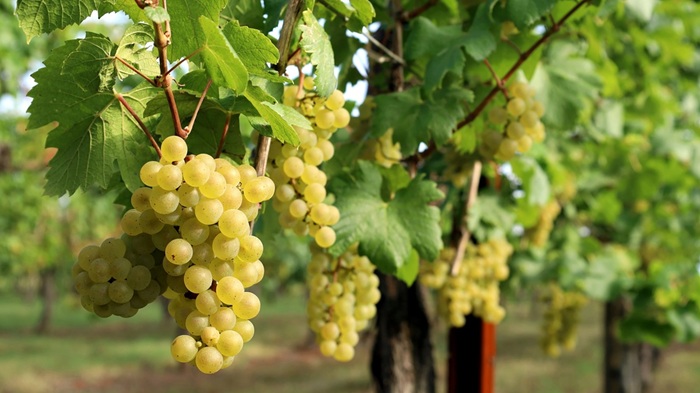
Also known as fié gris or Sauvignon Rose, it produces relatively small bunches with oval berries that turn a deep golden yellow when fully ripe. The fruit’s thick skin and melting pulp share certain similarities with Muscat. Earlier ripening than Cabernet Sauvignon but later than Sémillon, it is a vigorous variety, though somewhat sensitive to powdery mildew.
In France, Sauvignon Blanc is primarily found in Bordeaux, particularly in the Graves and Pessac-Léognan areas, where it produces fairly full-bodied wines, often aged in oak. It also thrives in other Bordeaux appellations including Entre-deux-Mers, Côtes de Blaye, Côtes de Francs, Côtes de Bourg, Graves de Vayres, Premières Côtes de Bordeaux and Sainte-Foy Bordeaux. Blended with Sémillon, it is used in the production of the great sweet wines of Sauternes and Barsac, as well as Cadillac, Cérons, Loupiac and Sainte-Croix-du-Mont. Sauvignon Blanc is also made into Crémant de Bordeaux using the traditional method of producing sparkling wine.
Its other major stronghold is the Loire Valley, notably Sancerre, Pouilly-Fumé, Touraine, Anjou and the Central vineyards. Here, the wines are dry and lively, with aromatic, herbaceous profiles. Its delicious fruity profile and floral nuances have made it a firm favourite on shop shelves. It is also grown in a number of other regions, including Provence (Bandol, Cassis, Coteaux d’Aix), the South-West (Bergerac, Côtes de Duras, Côtes du Marmandais, Gaillac, Pacherenc du Vic-Bilh, Monbazillac, Montravel, Côtes de Gascogne and Saussignac) and Languedoc.
Its expressive fruit, combined with its freshness, has also appealed to vineyards well beyond France. It is also found in Australia, New Zealand, South Africa, Chile and the United States, as well as in Italy.
Style of the wines
Lively and vibrant, Sauvignon Blanc typically produces wines enjoyed for their freshness. Its expression varies with soil – flint and gravel in Sancerre, clay-limestone in the Graves – but always retains a bright acidity and a marked sense of minerality. Typical aromas include boxwood and broom, alongside citrus – particularly pink grapefruit – and floral notes such as narcissus and iris. Hints of sage and blackcurrant leaf can also appear. The most mineral styles, often with a chalky edge on the nose, develop notes of flint and sometimes pencil lead.
In Bordeaux, when blended with Sémillon and occasionally Muscadelle, it takes on a broader, richer profile, with more pronounced fruit from these warmer soils. White fruits such as apple and pear, along with yellow fruits like peach and apricot, then come to the fore.
Sauvignon Blanc from New Zealand has vibrant flavours of elderflower, passionfruit and gooseberry, especially when from the South island.
When grown in South Africa, this variety displays herbaceous flavours and citrus and green fruit.
California also grows Sauvignon Blans, here aged in oak barrels like in Bordeaux. Due to this, it is sometimes given the name Fumé Blanc. The wines have high acidity and ripe citrus flavours. Following the Pacific coast down to Chile, here, we can find intense wines, with high acidity and ripe apple, citrus fruit and tropical flavours.
Wherever it is grown, its hallmark remains its refreshing, thirst-quenching character and lively acidity. But vintage quality is key. In the finest years, and in the hands of the best winemakers, its intensity can reach remarkable levels.
Also on the iDealwine blog:
Sancerre fan? Have you tried Menetou-Salon?