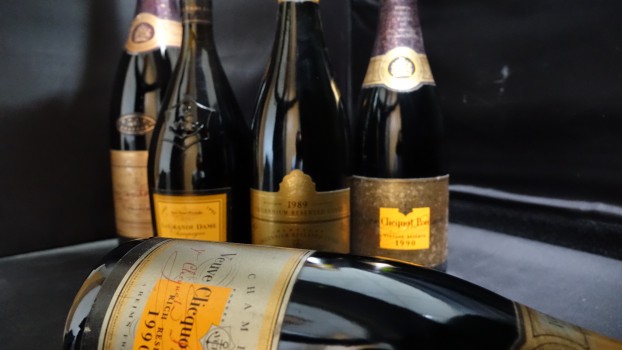
For some time now, we’ve noticed a trend emerging on the wine auction market: mature, fine Champagne is gaining value over time. In January 2026, this phenomenon was highly visible at iDealwine, most notably for bottles with several decades of ageing.
A longstanding icon: Dom Pérignon on top
We couldn’t talk about mature Champagne without mentioning the legendary vintages from Dom Pérignon, cuvées whose results at auction demonstrate a continued interest among buyers for older bottles.
For instance, a 1966 Dom Pérignon went under the hammer for €876, almost 89% higher than its estimated price. The estate’s 1969 vintage performed well, too, selling for €551, a value increase of nearly 47%. A 1995 Œnothèque cuvée also found a home when a Korean buyer made a winning bid of €751 (+9% on the price estimate). These results illustrate that not only age, but also the quality of the vintage itself, adds great value to the Champagnes in question, with these cuvées now in an exceptional phase of maturity.
These Champagnes have a singular profile due to their age. Far from the freshness and tension they might have expressed in their earlier years, these mature vintages boast complex notes of dried fruit, moka, honey and spices, inviting a more meditative tasting moment.
Rare bottle sizes, a winning feature
Another trend we’ve seen at auction is bidders being drawn to bottles outside the classic format.
For example, a magnum of Taittinger’s Comtes de Champagne in its 1988 vintage went under the hammer for €1,440 at iDealwine last month, an impressive 77% increase on its price estimate. The same can be said for Moët & Chandon’s 1985 Grand Vintage, a magnum of which sold for €551, an increase of 91%. A magnum of Jacquesson Champagne from 1996 also boasted a price increase, this time of 20% for a hammer price of €626.
Larger bottles such as these, reputed for a slower and more stable ageing capacity, are also produced in much more limited quantities. Over time, this makes them all the more sought after for their collector’s status.
Landmark cuvées still successful
Emblematic cuvées continue to play a driving role for Champagne on the auction market.
With this in mind, it’s worth noting the performance of Perrier-Jouët’s 1976 Belle Époque cuvée that sold for €313 (a 20% value increase), as well as a winning bid of €889 for Salon’s 1999 S cuvée (+14%). A mature bottle of Bollinger‘s Extra-Dry saw a huge value jump of 110%, going under the hammer for €263; proof that even non-vintage Champagnes can evoke great interest from bidders when the bottle has already been around for a few decades.
Demand for well-established names continues, too, with good auction results for Champagne by Henri Giraud, Krug, and Louis Roederer. We can glean from this that the classics are still safe bets on the auction market.
Grower Champagne: Recognising talent
The dynamic results for Champagne at auction are not only due to results for the historic Maisons, as producer Champagnes have also showcased some fine performances recently.
Jacques Selosse no doubt stands out with a 1998 Blanc de Blancs grand cru; this bottle went under the hammer for €1,565, an increase of 8% on its estimated value. Similarly, a 2004 Egly-Ouriet Grand Cru saw its value soar spectacularly by 146% with a hammer price of €401. We should also note a bottle from producer Marie-Noëlle Ledru that progressed in price by 42%.
These results confirm the increasing market power of terroir-driven Champagne, cuvées often produced in limited quantities that possess a strong, local personality. Grower Champagne has long been a small-time affair, but these bottles are now being actively sought-out by collectors, more of whom consider these crafted gems as genuine rivals to the region’s established names.
This phenomenon is, in fact, one of the most marked shifts on the Champagne market of the last twenty years.
For several years now, the way we look at Champagne has been evolving. Long considered a cork to pop for special occasions only, it is now increasingly appreciated as an ageing wine and a good companion for food. Sipped alongside an excellent meal, some would say bubbles can compete with the finest Burgundy and Bordeaux cuvées. As wine-lovers continue to realise Champagne’s fantastic potential for ageing, we will undoubtedly see its status shift … and we’re sure that more record-breakers are on the cards.
Read the most recent auction reports
Magnums, Jeroboams and Imperials shine at auction
What is the value of Château Mouton Rothschild wines at the moment?