The International Organisation of Vine and Wine (OIV) has released its latest overview of the global wine industry, examining production, consumption and trade flows. In the current climate, is the contraction of the wine sector inevitable? And what conclusions should wine enthusiasts draw in order to manage their collections with discernment? Read on to find out more.
The OIV, an intergovernmental scientific and technical body, remains a key reference point for the global wine sector. Its reports and analyses – always eagerly anticipated – offer a comprehensive overview of the industry’s position. At first glance, the findings from 2025 may appear sobering, whether in terms of production, consumption or international trade. Yet, as OIV Director General John Barker underscores, the sector continues to demonstrate notable resilience and adaptability. “In recent years, the wine sector has adapted to persistent climatic, economic and societal challenges. In 2025, disruptions to international trade stemming from tariff policies represented a further external shock that producers, exporters and supply-chain operators had to navigate.”
Production: vineyard areas slightly edge down
Is the decline in vineyard plantings inevitable? Recent vine removal schemes in certain regions might suggest that the sector’s contraction is accelerating. In France, a support programme introduced in 2024 led to uprooting 27,500 hectares of vines. This was supplemented by a specific plan targeting Bordeaux, bringing the total to 36,000 hectares. A further campaign, launched at the beginning of 2026, is expected to result in an additional 28,000 hectares being grubbed up. It is worth noting, however, that only one third of the applications submitted relate to a permanent cessation of wine production. The remaining cases concern adjustments intended to better align supply with evolving market demand. Against what has at times been an anxiety-inducing media backdrop, the OIV report makes clear that, at a global level, the reduction in vineyard area remained limited in 2025, at just -0.8%. Let us remember that vines are cultivated in 99 countries worldwide. The largest vineyard areas are found in Spain (13% of the global total), France (11%), China (10%) and Italy (also 10%).
Affected by severe climatic events once again, global production remained at a historically low level in 2025, only marginally above the small 2024 harvest. Output reached 227 million hectolitres last year, a modest increase of 0.6%. Italy retained its position as the world’s leading producer (accounting for 20% of total output), followed by France (16%), Spain (14%) and the United States (9%), with Australia, Argentina and South Africa next in line. Production rose by a staggering 81% in Brazil, and also increased in Australia, South Africa, New Zealand and parts of Europe, including Moldova and Greece – as well as Russia.
Global consumption, meanwhile, continued its downward trend in 2025, falling by 2.7%, with 208 million hectolitres drunk. The sharpest declines were recorded in countries where wine has historically been embedded in the culture, notably the United States – the world’s largest consuming nation (-4%) – alongside France (-3%), Italy and Germany (-4%). Meanwhile, consumption is rising in countries such as Portugal, Brazil and Japan, as well as in parts of Central and Eastern Europe. New consumer markets are also emerging, partially offsetting the downturn in the traditional consumer strongholds.
In France, wine remains the preferred alcoholic beverage.
In France – the world’s second-largest wine-consuming nation – wine continues to rank as the country’s preferred alcoholic drink, according to the 2026 SOWINE Barometer. In 2025, French nationals aged over 15 consumed an average of 39.7 litres of wine per capita. Should the 3% decline recorded in 2025 – in line with the global trend – be cause for concern? Or might it instead reflect a broader shift towards more occasional, but more qualitative, consumption centred on selected moments? It is worth recalling that in 1995, thirty years ago, per capita consumption stood at 58 litres. The SOWINE survey also highlights wine’s enduring positive image, 59% of respondents associate still wines with convivial or celebratory occasions. A proportion that rises to 67% for sparkling wines, with Champagne in particular retaining its place at the heart of celebrations. Another notable finding: while 60% of French respondents continue to associate wine with a good meal, this figure has declined by five percentage points compared with the previous year. Lifestyles are evolving, and so too are patterns of dining. What remains constant, however, is taste: among wine enthusiasts, flavour ranks as the primary driver of consumption.
Global trade under geopolitical pressure
Although volumes remain well above pre-Covid levels, the global wine trade is feeling the effects of an increasingly adverse geopolitical climate. Trade tensions, tariff policies and conflicts in various parts of the world have all contributed to a climate of uncertainty weighing on international trade. Unsurprisingly, US import volumes fell by 12% compared with 2024, a direct consequence of the tariffs introduced by the Trump administration. Globally, exports declined by 4.7% in volume and by 6.7% in value. Even so, it is worth noting that the share of wine traded internationally remains high, accounting for close to half of the global production (46%). In volume terms, the 2025 figure (€94.8 bn) represents a return to levels seen in the early 2010s. In value, exports remain elevated at €33.8 bn – comfortably above pre-Covid levels. The correction in value should be understood relative to the exceptional peak reached in 2022, a record that has not since been matched. Overall, the market continues to appreciate in value, suggesting that consumption trends remain oriented towards higher-quality wines.
What wine for today’s and tomorrow’s world?
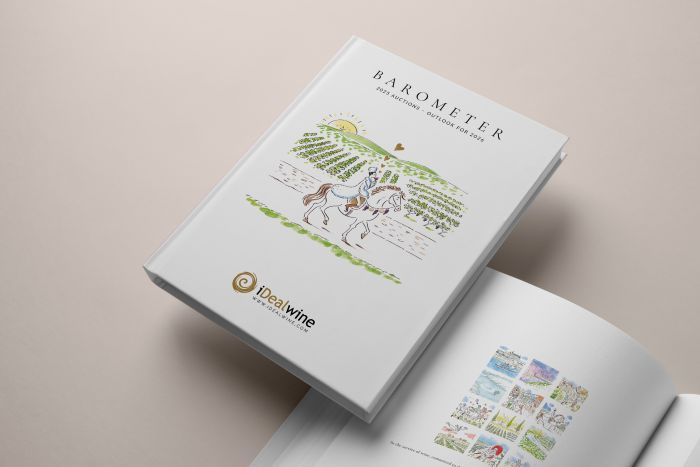
In this environment, the wine industry is demonstrating resilience and creativity. Not only in response to economic and geopolitical pressures, but more fundamentally to shifting lifestyles and patterns of consumption. A new relationship with wine is gradually emerging, shaped by the trends these figures reveal. Are enthusiasts drinking less frequently, and less often as part of a meal? Perhaps. Yet, wine is increasingly sought out for its flavour, its quality and its hedonistic appeal – its ability to elevate shared, convivial moments. Over the past decade, wine styles themselves have evolved to meet these changing expectations. iDealwine’s annual Auction Barometer offers evidence of this trend. It is perhaps one of the factors explaining why regions that have long remained under the radar are now enjoying an extraordinary resurgence. The wines from the Jura, Savoie, and Beaujolais regions, the volcanic terroirs of the Auvergne, and the more discreet corners of the Loire Valley are captivating a growing cohort of enthusiasts seeking wines that can be enjoyed in their youth, without requiring decades of cellaring to reveal their character.
The great traditional regions, meanwhile, continue to captivate leading collectors and enthusiasts worldwide. While Burgundy commands the strongest following – ranking first in value across iDealwine’s auction sales – Bordeaux retains its lead in terms of volumes traded. Champagne remains one of the most dynamic segments of the secondary market and, after Burgundy, the most highly valued by average hammer price (€201 per bottle, +16%). The Rhône Valley continues to represent a safe haven, forming the third pillar of the Bordeaux–Burgundy–Rhône trio, which together still accounts for the majority of auction activity (72% by volume). At the same time, wine lovers are steadily broadening the scope of their search. Regions such as Alsace, Corsica and the South-West are gaining ground in auction sales. International wines are also enjoying growing success – led by Italy – with 30 producing countries represented in iDealwine’s auctions in 2025. A sign, perhaps, of collectors’ curiosity and open-mindedness, and of a market that remains driven by the pursuit of discovery.
Among consumers’ evolving expectations, access to more ‘digestible’ wines now ranks highly. Alcohol percentage has become an increasingly decisive criterion. Producers have taken note, adapting their winemaking practices and favouring gentler extraction techniques – the much-discussed ‘infusion’ approach designed to preserve elegance and finesse. The 2025 Bordeaux vintage, currently being released En Primeur, offers a clear illustration: the wines have retained a striking freshness, praised by critics and echoed by the iDealwine tasting team.
The message for enthusiasts is clear: an extraordinary range of grape varieties, styles and wine regions remains to be explored. Even within those areas that may appear, at first glance, firmly anchored in tradition, boundaries are shifting and practices continue to evolve. This capacity to adapt, refined over several millennia, is part of what makes the world of wine so compelling, shaped as it is by the cultural expectations of those for whom it is crafted.
Read the 2026 iDealwine Barometer covering last year’s results.
Find out about the Bordeaux 2025 En Primeurs campaign
Request a free price estimate of your collection