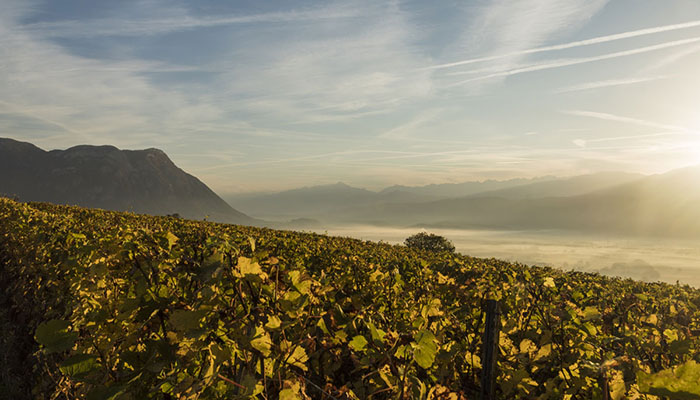
The region of Savoie is a historic figure in the French winemaking landscape. In fact, Savoyard vineyards were some of the first to ever be planted in France and the region has never stopped producing truly unique wines. Sparkling, whites, reds or rosés, Savoie offers us a kaleidoscope of colours, varieties and forms. Despite being so diverse, Savoir wines all have something in common – their originality. You will only ever find Altesse, Jacquère and Mondeuse planted in the vineyards located in Savoie, a fact that arouses curiosity for many.
Long dismissed as a source of simple “ski-resort wines”, this historic region has remained surprisingly under the radar among wine lovers, even to this day. A perception which is gradually fading since the arrival of a new generation of passionate winemakers with fresh approaches to vinification who are helping to reshape the region’s identity, to the point where Savoie is now attracting more attention than ever. Let yourself be carried by the authenticity of the finest Savoie wines as you explore their striking aromatic profiles and surprisingly impressive ageing potential.
From setbacks to triumph, the rise of Savoie
According to writers Pliny and Columella, the first traces of viticulture in Savoie date back to Antiquity. Even then, Savoie wines were recognised for their remarkable quality, a reputation shaped in no small part by Greek expertise. Although their early success can be traced to the Gallic Allobroges, it was above all the Romans and the medieval monks who drove the development of local viticulture. During this period, the monastic orders introduced numerous innovations, from defining vineyard parcels to conducting experiments in both vinification and viticulture. The result? A clear leap forward in the quality and precision of precious wines crafted in Savoie. The year 1860 marked a turning point for the region. Now annexed to France, its wines found themselves in direct competition with those from the country’s southern vineyards. This new rivalry was compounded with the phylloxera crisis that swept across France and shaped a rich and turbulent winegrowing period. Since then, the Savoie region has undergone a genuine renaissance, driven by a spirit of experimentation and an ongoing quest for precision.
A complex microclimate and a patchwork of soils
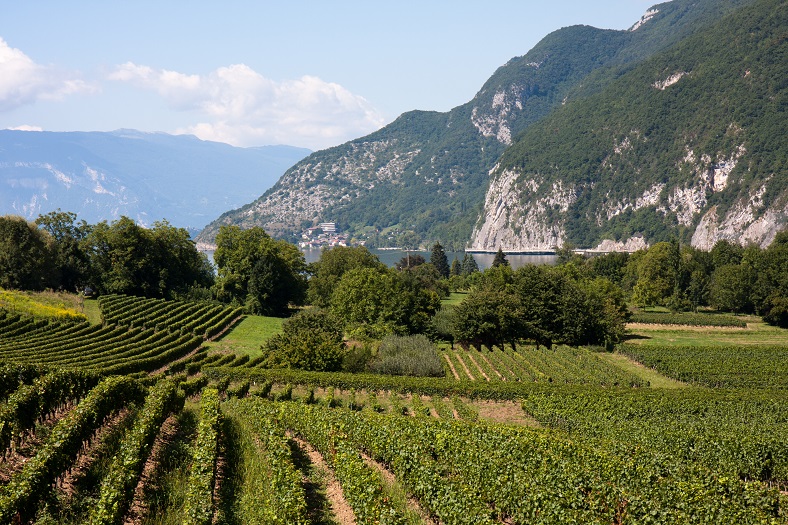
Savoie’s vineyards covers around 2,200 hectares (according to Insee) and stretches from Lake Geneva in Switzerland to Isère. This vertical sweep crosses the departments of Savoie and Haute-Savoie, as well as some parts of Isère and Ain. Around 80% of the vineyards lie within Savoie itself, with most of the vines concentrated south of Chambéry. The Savoie climate is essentially continental, shaped by Mediterranean influences to the south and oceanic ones to the north. Despite relatively warm late seasons, the conditions remain harsh, with frequent frosts that only the local grape varieties can withstand. Yet in spite of its Alpine chill and the altitude of the vineyards, the region benefits from a relatively warm microclimate, thanks in part to its south/south-east exposure. Nearby lakes and rivers also help temper the coldest temperatures.
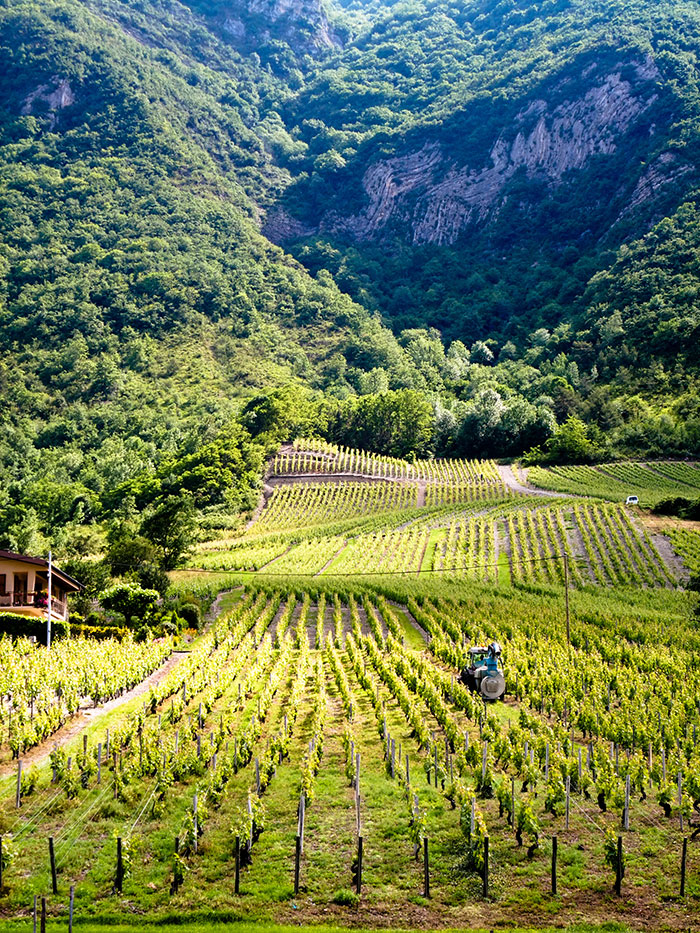
True to their Alpine setting, the Savoyard vines climb steep slopes. Rooted in quaternary alluvial soils of sandy gravel, stony scree and ancient glacial moraines, they flourish on mountainsides rising between 250 and 500 metres. With its distinctive terroir and unique microclimate, the region produces a range of robust grape varieties you won’t encounter on other continents.
Varieties as rare as they are complex
The Savoie region is home to 23 varieties (with white wines representing two thirds of wine production) and among them, the following varieties stand out:
- Jacquère: This is the most planted variety in Savoie and covers 50% of vineyards in the region. Lively, dry and mineral, these wines possess a beautiful freshness, releasing notes of white blossom, white peach, pear and grapefruit. Used in the production of six crus located in the Chambéry cross valley (Apremont, Abymes, Chignin, Saint-Jeoire-Prieuré), in the Savoie Valley (Cruet), and to the west of Lake Bourget (Jongieux).
- Altesse: Covering 10% of the land, the wines crafted from this variety are often very complex and have great ageing potential. In their youth, they possess bergamot, pineapple, quince, peach and fresh almond aromas. While, after a few years aging, notes of toast, white truffle and honey will rise from the glass. Also known as Roussette, this variety is also vinified on its own in the Roussette-de-Savoie appellation.
- Chasselas: Initially known as a table grape, this ancient variety is particularly well suited to Alpine terroir. It is grown in France and also in Switzerland, where it has become the country’s most planted grape variety. It produces dry white wines with a pale hue and a discreet nose. On the palate, however, the aromas are far more expressive, and when combined with low acidity and modest alcohol, they deliver beautifully supple wines. This aromatic strength means the wines are best enjoyed young, when their flavours are at their most vibrant. Some wines retain a touch of carbon dioxide; a light spritz that brings gentle liveliness to the wines. Wines with greater maturity show more concentrated, more pronounced aromas and a richer, more unctuous texture. Expect notes of dried fruits, almond, hazelnut, lime tree blossom, acacia and, at times, a mineral edge reminiscent of flintstone. As they reach full maturity, the dry whites develop a complex bouquet with notes of honey, mushroom or mineral tones. Its iconic AOC: Vin-de-Savoie (Crépy, Ripaille, Marin, Marignan).
- Mondeuse or “the variety that ripens with snow on the ground”: The iconic black variety of the region, these grapes does not happen to grow here by chance. In fact, as the Roman writer Columella wrote this variety is extremely resilient. It can grow on slopes made of limestone-clay scree and marl soils. Between its robustness and the richness of its flavours, Mondeuse delivers floral notes like those of violets and red fruit (red currant, raspberry and strawberry) and spice (cinnamon, clove and white pepper) aromas. These wines can also be aged for many years, for ten years or more.
The uniqueness of these varieties and there terroirs permeate through numerous wines from the region and call for the creation of diverse appellations.
A simple appellation system
Despite the many intricacies of the region, Savoie counts only three appellations: AOC Savoie, AOC Seyssel and AOC Roussette de Savoie. The region is also home to two Protected Geographical Indications, IGP Vins des Allobroges and IGP Isère, made in both white and red by producers including Domaine des Ardoisières and Domaine L’Aitonnement.
- AOC Vin de Savoie is, unsurprisingly, the leading appellation. It accepts a wide range of grape varieties and wine styles, from white and sparkling to red and rosé. In addition, AOC Vin de Savoie can be supplemented by one of the 16 regional designations that structure the vineyard.
For white wines, these crus are: Abymes, Apremont, Chignin, Saint-Jeoire-Prieuré, Crépy, Marin, Marignan, Ripaille, Chautagne, Cruet, Jongieux, Montmélian, Chignin-Bergeron, and Ayze. L’Apremont shines here through the wines of Domaine Chevillard and Domaine Giachino, producing wines that are intense and expressive, offering aromas of bergamot and elderflower. Chignin-Bergeron is equally well represented, notably by L’Aitonnement, André et Michel Quenard, Louis Magnin and Gilles Berlioz.
For rosé and red wines, the labels proudly feature the following crus: Saint-Jean-de-la-Porte, Chautagne, Arbin, Chignin, and Jongieux. To explore some of these Savoyard gems, consider the Saint-Jean-de-la-Porte from Domaine Chevillard, and the Arbin wines crafted by Louis Magnin or by André and Michel Quenard. Finally, for sparkling wine lovers, the Ayse made by the late Belluard offers marked minerality and impressive complexity.
- AOC Seyssel: This appellation forms a small pocket within the Ain. It is dominated by the Altesse, and the wines are generally recognisable for their robust, powerful structure.
- AOC Roussette de Savoie: Here too, Altesse is the leading variety. It must account for 100% of the blend for the appellation to qualify as a cru; otherwise, it may be blended with Chardonnay. The wines are distinguished by finesse, an intense delicacy which is beautifully expressed in the cuvées produced by Domaine Chevillard, Gilles Berlioz and Louis Magnin.
Iconic Savoyard winemakers
As mentioned earlier, Savoie has been enjoying a surge in popularity recently, and its wines are now increasingly present on top restaurant wine lists. Alongside iconic names like Michel Grisard (Prieuré Saint Christophe, now overseen by Domaine Giachino), the region’s reputation is also carried by several acclaimed producers, whose wines include:
- Belluard
- Gilles Berlioz – Le domaine Partagé
- Domaine des Ardoisières
- Marie et Florian Curtet
- Giachino
- Louis Magnin
- Les Vignes du Paradis