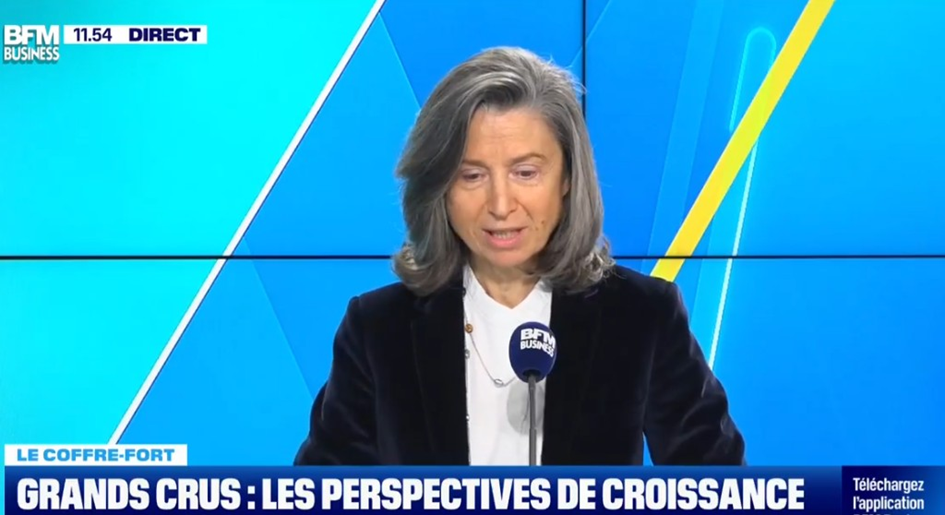
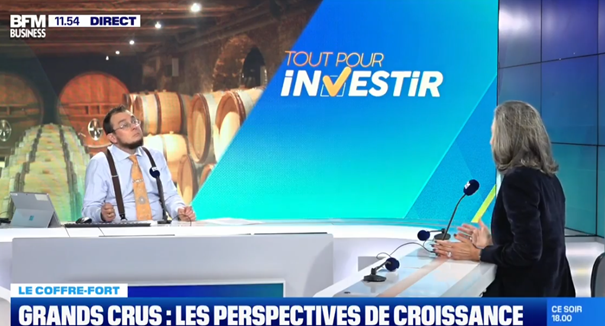
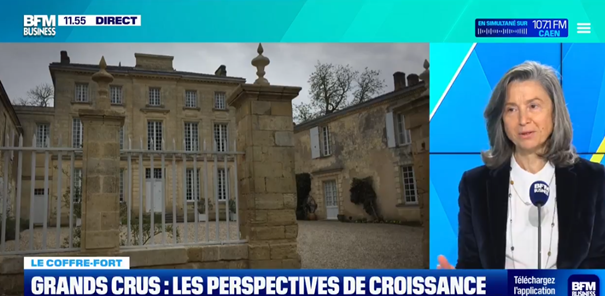
Angélique de Lencquesaing, co-founder of iDealwine, is interviewed every month on the French news channel BFM to comment on the latest trends in the fine wine market. She was interviewed by Antoine Larigauderie a few days ago.
In a highly volatile market, wine enthusiasts are seeking investments that combine – as much as possible – security and performance. Can fine wines be considered as a desirable alternative investment? We will analyse the different elements that influence this market and its components with Angélique de Lencquesaing, co-founder of iDealwine – an SME created 25 years ago – which has become a global website for wine auctions and fine wine price estimates.
Angélique, how is the market for selling grands crus evolving and what is the outlook?
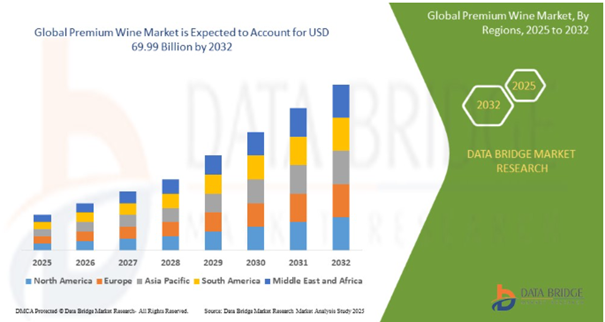
The first good news, Dry January has ended, reminding everyone who attempted the challenge – there were about 10 million worldwide and according to reports, a good quarter caved in to the call of Bacchus’ nectar – that moderate wine consumption throughout the year is preferable to any form of excess. In a wine market valued at $500 billion USD, “fine wines”, bottles with a value of more than $15 USD, account for about 10% of the total in 2025, the equivalent to a market value of $50 billion USD. Growth prospects in this segment are estimated at more than 5% per year (sources Premium Wine Market and Data Bridge Market Research).
The wine auction market, which we at iDealwine know more than any other, is narrower. It is valued at $500 million globally and in France, its size was close to €100 million in 2024. iDealwine is one of the major players, with a total auction sales value amounting to €42.4 million in 2025, a 9% increase compared to the previous year.
The fine wine market thus offers great growth prospects, yet consumption is stagnating – or even declining – around the world?
Global consumption is expected to be around 212 million hectolitres for 2025, down by about 1 % compared to 2024 (a level already at its lowest for over 60 years). The main established markets (Europe and the United States) are experiencing a gradual reduction of around 1 to 2% in the volume consumed per year. If we consider France, this decline has been massive since 1960. The French have indeed reduced their consumption by 60%, going from 57 litres per year per capita in 2000 to 34 litres in 2024. This is, in fact, an alcohol intake below the recommendations set by the Ministry of Health.
So why is the value of this market increasing, as previously discussed? Consumption patterns are changing – gone is the daily glass of wine, enthusiasts are now choosing carefully when to open a bottle, and when doing so, opt for wines of better quality. Drink less but drink better, that’s their motto.
Wine consumption is very concentrated in certain countries, isn’t it?
According to the International Organisation of Vine and Wine, wine is consumed in 195 countries today, practically all over the world! The organisation estimates that around 450-500 million people frequently or occasionally consumer wine. But it is true that more than 70% of consumption is concentrated in 10 major markets, with the United States of America being the top consumer. And what’s more, the top five countries (the USA, France, Italy, Germany, United Kingdom, and Spain) account for 51% of global consumption according to Decanter magazine. This does not stop those in other countries from discovering iDealwine, who is constantly opening delivery to new countries. In fact, iDealwine has customers in 60 countries, with delivery fees specific for each country, and starting to ship wine to each new market is a victory for the company.
What countries buy the most from your website and what is the share of sales from outside France?
France remains our primary market, but we are equally seeing a growing number of countries purchasing wine – mainly fine wine from France – from our website. 60% of iDealwine’s sales are driven by customers residing outside of France and this figure rises to 70% when only looking at auction figures. The main buyers are located in Asia (Hong Kong, Singapore, Korea, and Taiwan) and Europe (Italy, Germany, Switzerland, and Scandinavian countries).
What about the United States where iDealwine opened an office a few months ago? What has the impact on wine sales been since new taxes were introduced?
The American market is in a phase of unprecedented instability, which has severe consequences on the wine market. The threat of 200% taxes, which eventually materialised at the much lower 15% in spring 2025, nevertheless hindered shipments. Many European wine retailers have shifted their commercial efforts to neighbouring markets. For iDealwine, countries like Italy and Germany are extremely dynamic.
The mere imposition of 15% taxes can have the effect of slowing down consumption and sales. It that not so?
The price increase for enthusiasts based in the USA is significant in itself and may encourage them to turn to purchasing wines from other winemaking countries. Add to this the depreciation of the dollar that occurred in 2025 (-11.3%), and you practically double the effect of these taxes.
Conversely, to understand the impact of customs duties on the wine trade, take the example of Hong Kong. In 2008, the decision to abolish import taxes on wine had an immediate and massive effect. Hong Kong quickly established itself as the gateway for fine wines throughout Asia. A position that seems impregnable today. So yes, the issue of customs duties is crucial for developing the market. In this regard, promising prospects are opening up in India, with customs duties set to gradually decrease over the coming years from 150% to 25%. The ongoing negotiations on the Mercosur agreement, if successful, should open up promising opportunities for viticulture with, ultimately, a gradual removal of current tariffs. Provided that the agreement is ratified, of course…
Let’s move on to how the fine wine market is performing, which you follow closely. You mentioned a growth in auction sales value of 9%. It is a fine performance compared to wine sales in general. But if we compare the price evolution with the performance of the stock markets, is wine an interesting diversification option?
After a slight decline in 2024, the CAC 40 rebounded in 2025 by more than 10%. In general, stock markets have been buoyed, in a highly volatile context, by stocks linked to investments in artificial intelligence (especially in the USA with the famous “Magnificent 7”), as well as in the banking sector, commodities, and also, at the end of the year, the defence sector.
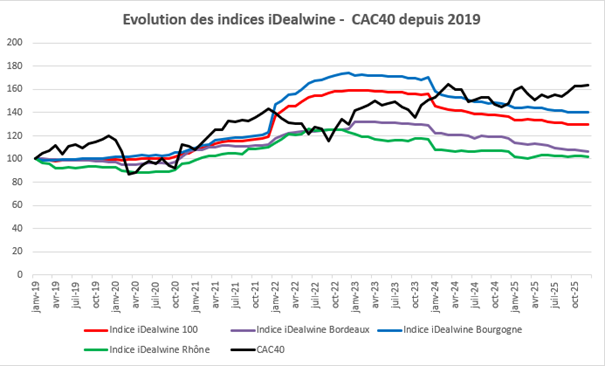
For several years, after a surge in 2022, prices on the fine wine secondary market have been declining, as traced by the Winedex® Indices. This year, among alternative investments, gold recorded a record surge in value (+60%). Difficult to compete with such a performance…
When it comes to wine, enthusiasts must exercise discernment in their choices, and above all, consider the appreciation in value of their collection over the medium to long-term. Moreover, we notice on iDealwine that while the traditional regions of Bordeaux, Burgundy, and the Rhône Valley remain safe bets, within these regions there are some hidden treasures. The Hospices de Nuits wine auction, which will take place on 8 March organised by iDealwine, is one such treasure. Because in the long term, these wines appreciate in value. Nevertheless, it is important today to diversify purchases by turning to regions with high potential for appreciation.
Where does this potential lie?
The talent of winemakers is now recognised in all regions. You have role models everywhere, talented winemakers who act as a driving force for their vineyard and region. By attracting the spotlight to their work, they not only generate demand but also encourage their peers to strive for the same quest for excellence. This emulation is favourable to areas such as Muscadet (Jérôme Bretaudeau, L’Ecu), Anjou (Richard Leroy) and Touraine (Chidaine, La Taille aux Loups) in the Loire, not forgetting Auvergne, a land of natural wines, Alsace (Deiss, Albert Mann, Zind-Humbrecht), Beaujolais (Métras, Lapierre, Hoppenot…), and Corsica (Canarelli, Vaccelli…). Not forgetting the wines from outside France, with Italian Piedmont leading the way. In the end, it is necessary to do thorough research to identify these winemakers and estates of excellence, which have their rightful place in a fine enthusiast’s collection. Investing in wine is not for the faint hearted; it requires a good level of knowledge and, above all… a lot of passion!
Request a free estimation of your wines
Read the most recent iDealwine auction reports
Find out more about selling your wines on iDealwine