Is climate change sounding the death knell for southern vineyards? Quite the opposite, says Angélique de Lencquesaing, who has observed growing interest in Spanish wines. Read on to find out more.
Angélique, you often tell us that wine lovers are naturally curious and always keen to discover something new. At the same time, rapidly evolving market trends shaped by changing lifestyles and, increasingly, by climate change are equally in play. With that in mind, what place should be given to wines from southern wine regions in a cellar? Today, we’re turning the spotlight on Spain’s vineyards. From an investment perspective, do Spanish wines have a place in a collection? These are precisely the questions we’ll be exploring at a time when heatwaves are becoming an ever more familiar feature of southern Europe.
Wine has long been woven into the country’s culture and history. The cultivation of vines in Spain dates back to antiquity and, as in France, much of its regions’ development can be attributed to the work of monks during the Middle Ages. Today, vineyards cover almost 919,000 hectares, making Spain the world’s largest winegrowing country, accounting for 13% of all planted vineyard area.
Far more than an everyday product, wine is an integral part of Spanish culture, history and gastronomy. While a number of historic estates established their reputations long ago, the country’s wine sector has undergone a remarkable qualitative transformation since the 1980s. Today, Spanish wines enjoy worldwide recognition, and Spaniards take considerable pride in this rich winemaking heritage.
The wine market appears particularly dynamic at the moment, judging by what you’re seeing at auction.
Generally speaking, enthusiasts showed strong enthusiasm for wines from beyond France at iDealwine auctions in 2025. This was certainly true of Italian wines, which accounted for the majority of non-French wines sold on the secondary market, representing 51% of volume. The same trend was evident across several other winegrowing regions that performed strongly last year, particularly Spain, the third most popular country after France and Italy, with more than 4,000 bottles sold through iDealwine. While this remains a relatively small share of total sales, it is a growing one – up 19% by volume – and, more significantly, 27% by value. Figures that speak volumes about the growing appeal of Spanish wines among collectors. And yet prices remain highly accessible, averaging €84 per bottle, compared with €137 across all iDealwine auctions.

What accounts for the appeal and growing success of Spanish wines today?
The diversity of Spain’s wines is one of its greatest strengths, and the country is home to wine regions that now enjoy international recognition and prestige. The largest is Rioja (63,000 hectares), one of only two Spanish regions, alongside Priorat, to hold the country’s highest classification, DOCa (Denominación de Origen Calificada), broadly equivalent to France’s grand crus or Italy’s DOCG wines. Of the most expensive wines sold through iDealwine in 2025, ten came from Rioja. The region is best known for its red wines, primarily made from Tempranillo, often complemented by Grenache. Rioja wines are renowned for their extended ageing, sometimes over many years, which gives them exceptional ageing potential. Two distinct schools coexist, historic estates with centuries of tradition, on the one hand, and more recently established producers on the other. Their winemaking philosophies often reflect markedly different approaches. In this respect, López de Heredia Viña Tondonia is a benchmark. A bottle of the estate’s 1964 Gran Reserva sold for €376 on iDealwine last year. Such longevity allows very mature vintages to command significant prices on the secondary market, as illustrated by a bottle of 1925 Marqués de Murrieta Castillo Ygay Reserva Especial, which sold for €657 in 2025.
But Spain’s greatest wine does not come from Rioja…
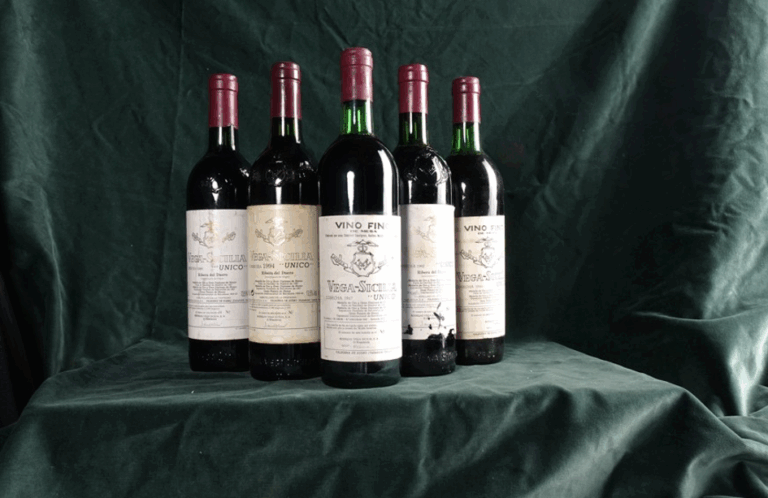
In fact, after more than 25 years spent analysing the fine wine auction market, we have consistently identified the wines of Vega Sicilia among the world’s greatest. Despite what its name might suggest, Vega Sicilia is not Italian. The estate’s history stretches back more than a century, but it was under the stewardship of the Álvarez family, who took the reins in 1982, that its reputation became truly global. Concentrated yet immensely elegant, this is a wine capable of provoking intense emotion. Rare and highly sought-after, it is especially prized in the more mature vintages. At iDealwine in 2025, a magnum of 1962 Único – produced from old-vine Tempranillo and Cabernet Sauvignon – fetched €2,003. It remains the most valuable Spanish wine on the market, a true legend that every wine lover hopes to taste at least once in their lifetime.
Rioja and Ribera del Duero’s historic estates feature prominently among the wines most sought-after at auction, but are other regions also making their mark?
Yes, some have risen to prominence more recently. In Ribera del Duero, for example, the success of Dominio de Pingus, founded by Danish winemaker Peter Sisseck in 1995, is a relatively recent phenomenon. A bottle of the estate’s flagship wine from the 2004 vintage changed hands for €914 on iDealwine last year.
Then there is Priorat, a highly rare and sought-after region covering just a few thousand hectares. Some maps barely mention it, despite the fact that it too has attained Spain’s highest DOCa classification. Winemaker Álvaro Palacios was among the handful of talented and visionary growers who helped spearhead the revival of Spanish wine in the early 1990s. The vineyards are rooted in an exceptional schist terroir that gives rise to wines of great concentration and power, yet also of legendary finesse. His flagship cuvée, L’Ermita – made from very old-vine Grenache with a small proportion of Carignan – was the third most expensive Spanish wine sold on iDealwine last year, fetching €876 for the 2012 vintage. Attention should also turn to wines produced in the Madrid region, and in particular to a small, relatively young estate founded in 2008 that has enjoyed meteoric success at auction, Comando G Its flagship Grenache, Rumbo al Norte, is produced in quantities of only around 1,000 bottles per year. A bottle in the 2018 vintage reached €814 at auction.
How have these wines, born of a warm, sun-drenched wine region and therefore powerful, achieved such success?
Admittedly, Spain is best known for its great red wines, which account for around 55% of production. These are often full-bodied wines, whose concentration is enhanced by both winemaking choices and extended ageing. They possess a strong identity shaped by native red grape varieties such as Tempranillo, Grenache (Garnacha), Monastrell and Mencia; while Spain’s leading white varieties include Albariño, Verdejo and Palomino, the grape behind Sherry. Some of the estates mentioned previously cultivate their vines at altitude to preserve freshness in the berries, Comando G is a good example. Today, they have adapted both their winemaking and ageing practices to produce wines that are more approachable, refined and easy to digest. Even at Vega Sicilia, techniques continue to evolve, with part of the ageing now taking place in stainless-steel vats and, in some cases, amphorae. Many Spanish estates deserve the attention of wine lovers and collectors alike!
Request a valuation of your wines
Find out more about selling your wines on iDealwine