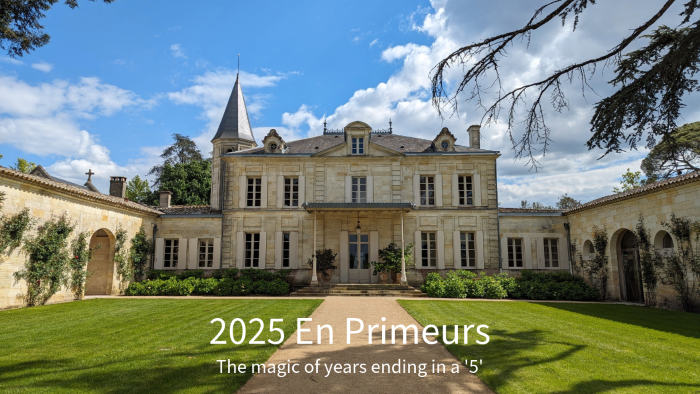
How did the 2025 growing season unfold in Bordeaux? What can we expect from this vintage in the glass? Here’s what we know so far! Let’s cut to the chase: 2025 is shaping up to be an outstanding vintage! Here is our detailed analysis of the 2025 vintage in Bordeaux.
Just like every year, the iDealwine team will be in Bordeaux to assess the new vintage firsthand, with detailed tastings set to follow. Océane and Raphaël from the Bordeaux office, alongside Elsa, Angélique, Victor, – and even Cyrille, our CEO – will be sharing their impressions and standout favourites from the tastings.
We’ll be reporting back as the tastings unfold. In the meantime, early analyses are already highly encouraging, starting with the much-anticipated report from the Institut des Sciences de la Vigne et du Vin (University of Bordeaux), authored by Professor Laurence Geny, Elodie Guittard, Dr Valérie Lavigne and Professor Axel Marchal.
Vintage weather conditions: 2025, a perfect year despite global warming
Following a demanding 2024 marked by difficult weather conditions, the 2025 growing season offered Bordeaux winegrowers a welcome respite, with near-ideal conditions throughout the cycle.
A mild, largely dry winter
Winter was generally mild and relatively dry. Rainfall was slightly above average in January, before falling below normal in February and March, while temperatures remained consistently above the 30-year average. A brief cold spell in February helped prevent overly early budburst, an important safeguard against spring frost given the otherwise mild winter. Budburst occurred in the first ten days of April.
Dry, mild spring favouring excellent vine health
The vegetative cycle resumed in early April, initially under relatively wet conditions, before a shift to warmer, drier weather from mid-April onwards. These conditions supported steady vine growth while keeping disease pressure low, with limited downy mildew thanks to good sunshine and low rainfall. From late May, rising temperatures further advanced the growing cycle.
Flowering started fairly early at the end of the month and progressed swiftly and evenly, paving the way for even ripening, with no issues of coulure (failed pollination of the blossom) or millerandage (where grape bunches contain berries that differ greatly in size). Fruit set followed under similarly favourable conditions. Early water stress helped to limit berry size while promoting the synthesis of phenolic compounds. From this stage onwards, however, the overall yield potential already appeared limited.
A hot, dry summer balanced by timely rain
Summer set in firmly, further accentuating the vintage’s early development. A few stormy episodes occurred in June, sometimes intense and occasionally accompanied by hail, but damage across the vineyards remained limited. Overall, rainfall became increasingly scarce throughout the month.
Low rainfall led to a gradual increase in water stress, which eventually halted vine growth before veraison (the onset of grape colour change and maturation). This began at the end of July and proceeded swiftly and evenly over a period of around ten days. In mid-August, a spell of intense heat set in, followed by much-needed rainfall towards the end of the month. These timely showers allowed the grapes to ripen fully under favourable conditions, avoiding any risk of over-ripeness.
Harvest conditions were ideal, affording considerable freedom in choosing harvest dates
The white harvest started just before mid-August and became widespread in the second half of the month. These early harvests helped preserve high levels of acidity, key to the wines’ balance, while ensuring excellent aromatic potential.
For the reds, the first Merlots were picked in early September under favourable conditions, again allowing for considerable freedom in determining harvest dates across the plots. Cabernet Sauvignon followed over the course of September, confirming the vintage’s early characteristic. Here again, quality potential was clearly evident in the reds, with grapes both perfectly ripe and healthy.
Sauvignon Blanc was harvested from as early as 11 August. The grapes were sweet, highly aromatic, and retained good acidity. Sémillon harvests, equally early, began on 14 August. The grapes were similarly balanced and aromatic (white and yellow fruit), bringing texture and generosity to the blends.
In Sauternes, harvest conditions were also ideal – which is never a given, as the development of botrytis depends on very specific weather patterns. Alternating humid and dry periods allowed both the onset of noble rot and berry concentration. Harvests started around 20 September and were carried out in successive passes, continuing through to mid-October. The yield reached an excellent level of quality, with strong aromatic potential, alongside very good volumes.
*
In summary, 2025 stands out as a high-quality vintage shaped by excellent weather conditions, in line with the broader context of climate change, which continues to bring warmer, earlier-growing seasons and earlier, more compressed harvests. Crucially, the vintage appears to have avoided the typical drawbacks of warmer years, such as over-ripeness, low acidity and excessive alcohol, likely thanks to well-timed rainfall at key moments throughout the year. Despite these extremely favourable conditions, the 2025 vintage volumes remain limited. The small size of the inflorescences (clusters of flowers borne on a shoot), resulting from the difficult conditions in 2024, impacted the 2025 crop through floral induction (the physiological process by which a leaf bud develops into a flower bud).
Wines of excellent quality across the board
Overall, the reds reach a remarkable level, with slight variations between sectors due to localised rainfall during ripening and in the run-up to the harvests. Merlot produced particularly expressive fruit, combining freshness with fine depth, without any trace of over-ripeness. Cabernet Sauvignon is similarly fresh and fruit-driven, with very good sugar-acidity balance: pH levels are among the lowest recorded in recent years (it should be noted that lower pH corresponds to higher acidity), while levels of alcohol remain moderate, at around 13.3%. These qualities may come as a surprise given the warm nature of the vintage. No vegetal notes are perceptible on tasting, and the wines also display good density and structure.
Dry whites show very fine balance, delivering wines that are extremely fresh and expressive, with good substance and a supple, fleshy texture. However, volumes are low for this strong white vintage, with yields rarely exceeding 20 hl/ha.
Sweet wines are highly aromatic, with notes of white flowers and candied citrus.
As you will have gathered, 2025 is shaping up to be a great vintage in Bordeaux, an encouraging prospect for both growers and wine lovers alike.
For the latest news on the 2025 En Primeur campaign (notes, reviews, release dates, pricing and appellation-level analysis) be sure to sign up for our En Primeur updates!